
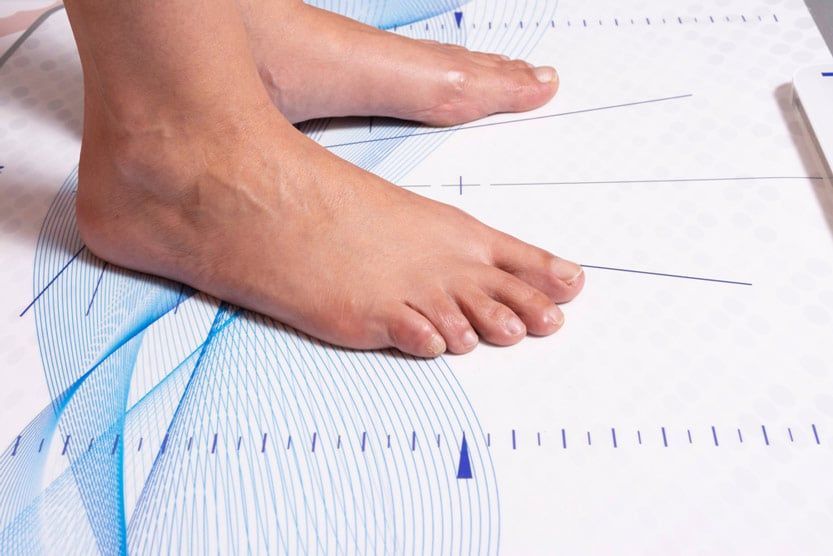
A biomechanical assessment involves analysing the way your body moves when standing and walking. It looks carefully at the positioning of the joints in your body and how they move, as well as strengths and weaknesses in the muscles and whether imbalances are having a detrimental effect. Weaknesses in certain areas can cause the body to struggle with the various stresses and strains of everyday life. Add in things like running and walking and the problems can go into overdrive, resulting in injuries and pain. This is why biomechanical assessments can be extremely valuable.
When Should You See a Podiatrist for The Assessment?
If you develop pain in the lower limbs, knees or feet with no obvious explanation, you may benefit from a biomechanical assessment. Examples include (but are not limited to) heel pain (plantar fasciitis), shin splints, forefoot pain, bunions, Achilles pain, and knee pain. All these forms of pain or injury can be as a result of a mechanical imbalance in the lower limbs. It is also wise to have an assessment if you plan to increase your activity levels, since addressing any weaknesses could reduce your risk of developing an injury.
How Does the Assessment Work?
It starts with a thorough medical history followed by a chat about the issue you are experiencing. An accurate diagnosis relies on getting the full details of the history, so expect to be asked several questions. The analysis will look closely at the foot, knee and hip in order to get a comprehensive picture of your lower body's kinetic chain. The aim is to identify what is causing what; for example, a foot imbalance may cause issues with the knee or hip, or it could be the other way round.
Non-Weight Bearing
During this assessment, we will look at your range of motion in the hips, knees, ankles and feet. Restrictions in movement may be as a result of arthritis, previous injuries or muscle tightness; whereas increased movement may be from generalised hypermobility.
Weight-Bearing
We will ask you to carry out a series of exercises whilst standing, such as single-leg standing or squatting. We will do some resistance tests against your feet, whilst standing, which will give an indication of where and how much force you are putting through each foot.
Gait Assessment
We will also visually assess your gait while walking or running, observing you from a number of angles. We can capture this through a video recording so we can slow down the footage and allow us to explain exactly what is happening.
Treating The Issues
Once the assessment is complete, your podiatrist will create a tailored treatment plan for you. This might include exercises designed to address issues with muscle imbalances that are causing undue stress on certain joints, ligaments or muscles. You may also be recommended orthotics to reduce stress on the affected area. The treatment plan is devised with you so that you can identify your goals for recovery.